Why Smaller Vehicles Electrify Faster
From Golf Carts to Excavators: How Size Matters
Over my years of driving electric cars, and working with truck, bus and off-highway companies, I’ve noticed a clear trend. The smallest vehicles are often electric, the biggest rarely are (so far).
Golf carts are 80%-90% electric. In some countries where smaller 3-wheelers are used, such as India, the electric share is much higher than for cars.
Cars, the next step up in size, electrify slower. The trend of larger vehicles electrifying slower can also be seen if we look at types of cars.
Fully electric SUVs were introduced several years after other smaller cars such as the Chevrolet Bolt, Tesla Model 3, Nissan Leaf, and Hyundai Ioniq. And heavy pickup trucks have a much smaller electrification share than cars.
As we go to even bigger vehicles, commercial trucks electrify at a slower rate than cars, and medium and heavy-duty trucks electrify slower than vans or small trucks.
If we consider off-road equipment, we see a similar trend. Smaller equipment such as forklifts has electrified much faster than larger equipment such as bulldozers. We also see this within categories: mini excavators have had many electric models available for a number of years already, while electric sales for larger excavators are much smaller. Smaller tractors at least have some electric models available, while the larger tractors (over 5 tonnes) do not have electric versions.
The reason electrification suits smaller vehicles and equipment like this wasn’t immediately obvious to me at first, especially after being confused by many people making wrong or incomplete arguments, but after years of working with components, vehicle and equipment companies, I think it mainly comes down to two key reasons.
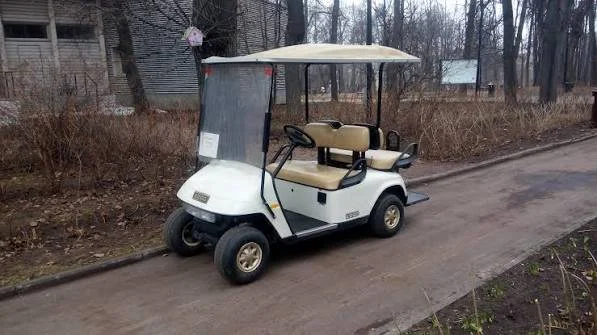
Golf carts sold today are already mostly electric.
1. Battery Costs Scale Up With Size
The main reason for this is underappreciated as many people don’t understand it and it’s slightly tricky to explain.
Of course larger electric vehicles have more expensive batteries. But this doesn’t fully explain it: most components of larger vehicles will be more expensive.
The key thing to understand is that if you increase a vehicle’s weight by 10x you tend to get 10x the needed battery kWh, but only increase the engine size and power by more like 2-5x. (Trucks and buses accelerate more slowly than cars as a result.)
This means that as you go to larger vehicles the cost of the electric vehicle increases more notably. For diesel vehicles the cost is focused more in the engine and other components that don’t increase as much at higher weights. This might mean that if you double the weight of an electric vehicle you might increase its cost by 1.8x, but for diesel that number might be 1.5x.
Another way to think about it is double your vehicle weight and you don’t double your powertrain needs but you do double your energy storage needs. Electric vehicles have a higher proportion of their cost in their energy storage.
This means that for larger vehicles and equipment diesel (or petrol) has a greater cost advantage, at least if we only consider the cost of the vehicle rather than the running cost. And this will limit the demand, making it harder to reach the necessary economies of scale.
But the price of batteries has been continually reducing. That’s why over time we go from electrifying sedans to SUVs to small trucks and eventually to bulldozers and huge excavators. Each step along the way to larger and larger vehicles is unlocked by battery prices reaching a new low.
2. Smaller Vehicles Are A Better Fit to the Existing Grid
The second reason why smaller vehicles are more frequently electric is that smaller vehicles fit existing infrastructure better, so cost and hassle associated with connecting to the grid are minimal. The smallest cars and forklifts can often even be charged in a standard electrical outlet, but trucks and buses cannot. This means negotiations with utilities and other stakeholders are needed before projects can get off the ground. Vans can charge using existing 50kW and 100kW chargers built for cars, but larger trucks require their own depots with new cabling and grid connections.
This inevitably has an impact on buying decisions if we compare a car or forklift that you can buy and start charging today or next week, versus a heavy-duty truck that might require months of negotiations and planning before you start charging it.
Hours a Day (Duty Cycle)
Some of my customers explained that the reason some vehicles (heavy-duty trucks, tractors, excavators) are slow to electrify is because they are used for too many hours a day for electric to be practical. And yet I have an electric lawnmower that works perfectly with battery swapping so could in theory be used all day without stopping to charge (I charge one pair of batteries while the other one is being used). Some forklift users I interviewed last year reported doing the same thing to use forklifts non-stop.
Why does that not work as easily for larger vehicles? Firstly, the size of the batteries makes swapping them more complex. You can’t just have someone pick them up in their hands: you need an expensive machine. Secondly, the additional battery for battery swapping makes things more expensive, whereas for a smaller lawnmower the spare battery is a smaller fraction of the total cost. Thirdly, the spare batteries can’t be as easily charged with existing infrastructure, because they need higher power.
So we are actually back to the same two arguments above.
Exceptions to the Rule
This rule that larger vehicles electrify slower won’t fit every case since there are so many other factors in addition to the two I mentioned. For example, mining machines may be electrifying faster than tractors even though tractors are smaller. This is likely because mining companies are larger and therefore have environmental goals and have more resources to deal with charging and investments in new technology, while tractors are run by smaller businesses that do not have the resources.
Mining (sites where fixed infrastructure can be built in for the long run) may electrify faster than machines used on temporary construction sites (where it isn’t worth investing in electric infrastructure for only a few months).
City buses do sometimes see high rates of electrification in spite of being a large vehicle, and this is because of public sector involvement including subsidies and grants, electric vehicles being well suited to city speeds, and a stronger demand for clean air in cities.
Summary
However, the general rule is that larger vehicles are slower to electrify because the battery cost scales up with the size, and because of infrastructure.
To understand what Fox Research Services can provide, click here.