Why is the Most Efficient EV a Decade Old?
10 years ago the fully electric Hyundai Ioniq (of which there were also hybrid and lesser-spotted plug-in hybrid versions) was rolling out to customers across Europe (including the UK), having been introduced in South Korea earlier in 2016. And the first customers getting their hands on the car started to notice something interesting.
It was efficient. Very. It glided along rather serenely and soon the early adopters were going online and raving about the car and posting stats. You could genuinely get better than 5 miles per kWh across a mix of highway and city driving while most others were getting between 3 and 4.
The car picked up a loyal following more from word of mouth, as it didn’t have a big advertising campaign. While people remember the Tesla Model S, Model 3, and Nissan Leaf as early EVs from that time, the underrated, reliable Ioniq is somewhat forgotten by those who have only been writing about EVs for a few years. But if you are a true EV nerd then you know of it.
Some of this comes down to the sales numbers. The Ioniq took a few years to get to 100,000 sold globally and without the hybrids it didn’t even reach that. Meanwhile the Tesla Model 3 and the Nissan Leaf sold bigger numbers that still continue to this day.
The original Ioniq got an upgraded version in 2019-2020, before being retired in 2022. The word “Ioniq” which was originally the name of that first model then became Hyundai’s electric sub-brand with most Hyundai electric cars sold as models such as Ioniq 5, Ioniq 6 etc.
How The Ioniq Still Wins
So how do 2026 cars compare to the original efficiency trendsetter? How much have EVs improved in a decade? The slightly surprising answer is not at all. The Ioniq is still the most efficient electric car, and therefore the most efficient car full stop.
That is my opinion, and it’s not universally agreed. A few cars have come close but after reviewing all the claims and studies and anecdotes, and tests where people drove both cars along the same route in the same conditions, that is my conclusion.
The Tesla Model 3 got close to the Ioniq, and of course it’s a bigger, heavier car so it’s the more impressive engineering achievement. However, in miles per kWh, the Ioniq is slightly better. The 2026 Model 3 is the most efficient Tesla yet, and now it’s very close to the 2016 Ioniq. Close enough that we have to ask what tires we are using, what variant etc.
The Mercedes CLA 250+ and Lucid Air both have impressive engineering, but are not quite able to catch up to the Ioniq on pure efficiency due to the cars’ greater weight.
So the Ioniq, which I still own, probably still just about holds the trophy of most efficient car ever. (Unless there was a car sold only in China or Japan that I missed.)
Compact Cars
You would think a more compact car would beat both of them, but those cars, aimed at urban driving, rarely have precision engineering or aerodynamic shapes. In fact, a very aerodynamic shape is just harder to do in a tiny car. So the Ioniq, at 4.5m, even just beats all the smaller cars (the Dacia Spring is very close), unless we’re going to talk about tiny 1 and 2 seater vehicles that can’t even go on the motorway and can’t really be called a car.
Whether or not you agree with me that the 2016 Ioniq still hasn’t been beaten on efficiency it seems at least fair to say that the most efficient EV in 2026 is still about as efficient as the most efficient EV was in 2016. So it is still an interesting question about why there hasn’t been any improvement.
There have been massive improvements from 2016 to 2026 if we consider charging station quality and availability, battery technology, charging technology (especially speeds) and software, so why haven’t we seen any improvement in efficiency, even though EVs a decade ago were in their infancy?
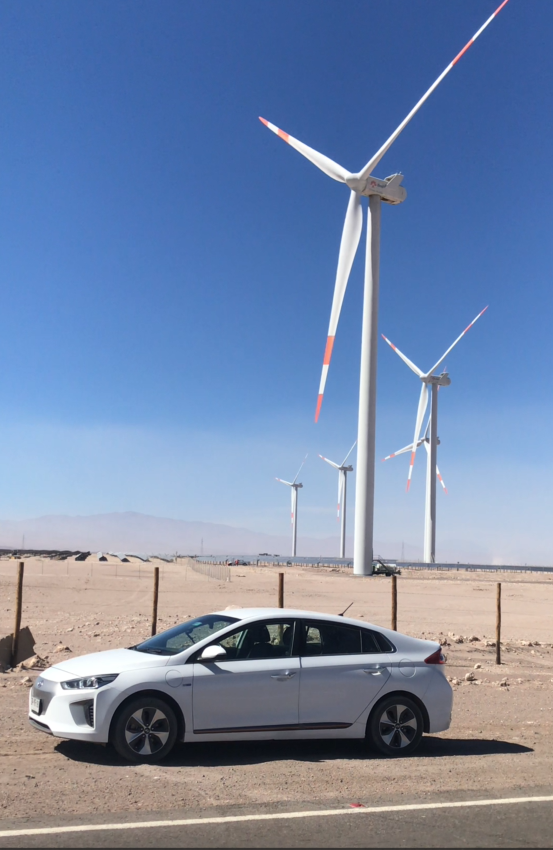
I was able to get 7 miles per kWh in my Ioniq BEV while driving at 35mph through the Atacama desert in an area without charging stations.
Reason 1: Battery Size
The original Ioniq had 28kWh (later upgraded to 38kWh) due to the high battery prices in 2016 and the resulting low weight gives it an advantage in energy consumption. Some modern cars would beat it slightly on energy consumption if they didn’t have bigger 50-80kWh batteries. Very few people are going to want a 5-10% more efficient car if it means winter range is 100 miles rather than 200. However, manufacturers can produce batteries at a much lower weight per kWh than they used to, so that doesn’t fully explain it.
Reason 2: Most People Don’t Care About Efficiency
Ioniq fanboys tended to range from people that want a sensible, reliable car to proper geeks that like to drive slowly behind trucks at 60 mph and then when they get home spend their time doing calculations about their efficiency. The latter is a pretty niche market – most people don’t care about efficiency that much, and efficiency doesn’t matter as much for EVs given how cheap they are to drive. People care about range, and OEMs have preferred to deal with that by just adding larger batteries. Aerodynamic cars are not a rarity, but they are certainly not the default. Most people want something that looks spacious, and given battery costs continue to tumble, OEMs think there’s no need to over engineer the shape to the nth degree when they can just spend $1,000 more on the battery instead.
Reason 3: The Focus is Still on Bigger Cars
And obviously SUVs and pickup trucks, which remain dominant, are not going to break any efficiency records.
Reason 4: Powertrain Components Are Already Efficient
I’ve interviewed manufacturers of components such as motors and inverters many times during my career. And these components were already good in 2016 because they weren’t groundbreaking tech. EVs were only being held back by the weight and cost of batteries at that time. Everything else has been ready to go technologically speaking for decades.
There’s a limit to how much more efficient you can make powertrain components as each of them was already well over 90% efficient years ago. Now there are companies out there selling more efficient, better-quality components, but the question is: is it really worth it to change suppliers and pay more to get from say 95% to 98% efficiency on a component? Those who say it is talk a good game, and they are probably right for performance cars, expensive cars, and some other niches, but the mass market hasn’t seen a need to move in that direction: at least not very quickly.
Is There a Niche?
Any one of the big OEMs could make a car that beat the original Ioniq’s efficiency if they truly wanted to. But that’s not where most of the market is. Personally, I think there is still a gap in the market for an inexpensive, efficient, aerodynamic, small car with fast charging, a nice interior and modern software.
The new Ioniq 3 comes reasonably close to what I’m imagining here, although it isn’t quite there in the sense that it isn’t a car that hypermiling geeks will get excited about. But then again there are not that many such people to sell to, and the Ioniq 3 looks more sensibly aimed at a bigger market. We will find out in the next few months whether or not the Ioniq 3 can help Hyundai beat its own 10-year-old efficiency record. I’m betting it won’t.